Heartwood Shaker 3-Drawer Nightstand (Proposed)
A proposed build — a copy of the Vermont Furniture Designs Heartwood Shaker 3-Drawer Nightstand (product page, archive), with the proportions taken from the maker’s photos and drawing. Three equal drawers stacked under a top that flares out past the case at the ends, four straight legs, an arched apron across the front, and frame-and-panel sides.
Provenance of the numbers. The maker publishes only the overall size and the construction notes. (stated) = from the maker’s page. (derived) = worked out from other numbers here so everything closes. (est.) = measured off the maker’s front photo, dimensioned drawing and three-quarter photo — good to about ±¼″ at best. The front/back overhang in particular is borrowed from a sibling model (the Heartwood Shaker End Table), because it cannot be read from a front view. Check the (est.) items before cutting.
Stated by the maker
| Item | Value |
|---|---|
| Overall | 24″ W × 18″ D × 28″ H (stated) |
| Drawers | 3, dovetailed; beech sides, backs and bottoms; high-end metal slides (stated) |
| Knobs | Matching hardwood (stated) |
| Case | Solid-wood sides; hardwood-plywood back (stated) |
| Species | Cherry, maple or walnut (stated) |
| Finish | Cherry/walnut: hand-rubbed linseed oil + wax. Maple: tung oil + wax (stated) |
Drawings (true scale)
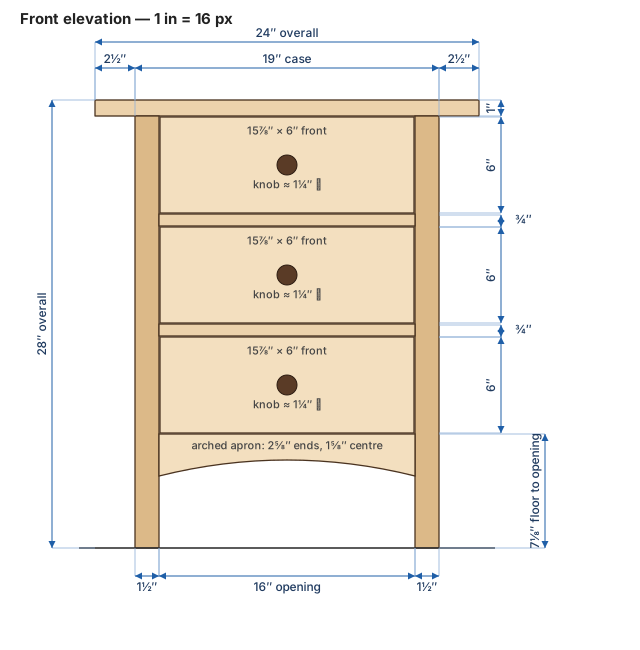
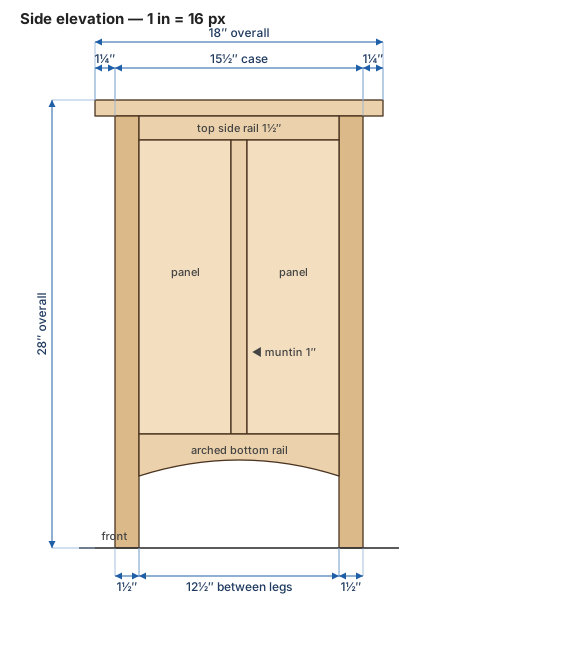
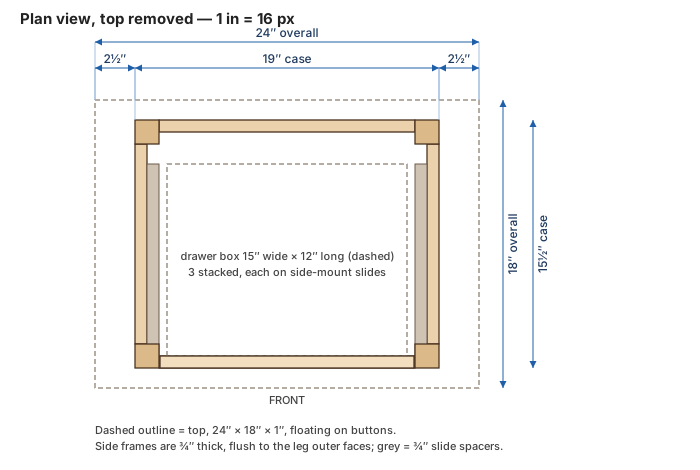
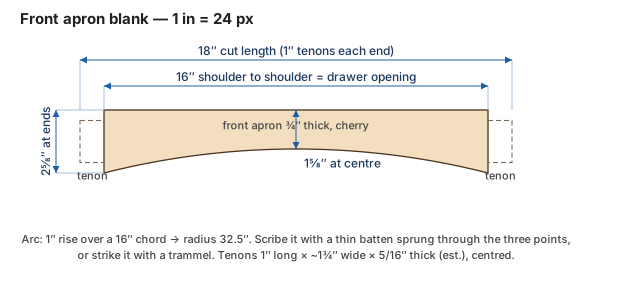
Drawn at 1″ = 16 px from the dimensions on this page. Click to open full size.
Front elevation
Side elevation
Plan view, top removed
Arched front apron
The ratios
| Derived | Working | Result |
|---|---|---|
| Case width | 24 − 2 × 2½ (end overhang) | 19″ (derived) |
| Case depth | 18 − 2 × 1¼ (front/back overhang) | 15½″ (derived) |
| Drawer opening between legs | 19 − 2 × 1½ | 16″ (derived — matches the ≈16″ measured on the photo and drawing) |
| Drawer front width | 16 − 2 × 1/16 | 15⅞″ (derived) |
| Drawer stack | 3 × 6″ + 2 × ¾″ rails + 6 × 1/16″ reveals | 19⅞″ (derived) |
| Floor to bottom of lowest opening | 28 − 1 (top) − 19⅞ | 7⅛″ (derived — matches ≈ 7¼″ measured) |
| Front apron, ends / centre | 7⅛″ band: ends 2⅝″, centre 1⅝″ | 1″ rise (est.) |
| Proportion | Value |
|---|---|
| Width : height | 24 : 28 ≈ 0.86 : 1 |
| Width : depth | 24 : 18 = 4 : 3 |
| Case width ÷ overall width | 19 ÷ 24 ≈ 0.79 (each end overhang ≈ 10.4 %) |
| Drawer front height ÷ width | 6 ÷ 15⅞ ≈ 0.38 |
| Drawer stack ÷ overall height | 19⅞ ÷ 28 ≈ 0.71 |
| Floor to opening ÷ overall height | 7⅛ ÷ 28 ≈ 0.25 |
To resize: multiply every dimension by one factor k and the proportions hold; round the stock thicknesses (¾″ rails, 1½″ legs) to what you have and keep the drawer fronts equal.
Dimensions that are estimates
| Item | Value | Basis |
|---|---|---|
| End overhang | 2½″ | ≈ 2½″ scaled off both the front photo and the dimensioned drawing |
| Front/back overhang | 1¼″ | Not visible from the front; matches the maker’s Heartwood Shaker End Table (listed 1¼″ front/back, 2″ sides) |
| Top thickness | 1″ (thin edge, bevelled underneath) | ≈ 1″ in the front photo; the three-quarter photo shows the edge tapered to roughly ⅜″ |
| Leg section | 1½″ square | ≈ 1.5″ in the drawing; ≈ 1.1–1.4″ in the photos, so it may be a little lighter. 1½″ makes the 16″ opening close |
| Drawer front height | 6″ | ≈ 6.0″ in both straight-on views |
| Rails between drawers | ¾″ | ≈ 0.85″ visible including reveals |
| Knob | 1¼″ diameter, centred on each front | Round, ≈ 1¼″ in the front photo |
| Top side rail / muntin | 1½″ / 1″ | Three-quarter photo shows a top rail, one centre muntin and two panels per side |
| Slide clearance | ½″ per side | Typical side-mount metal slide; confirm against the slide you buy |
Cut list
T × W × L, cut to length. 1″ tenons are baked into rail lengths. Cherry for the case and drawer fronts; beech (or maple) for drawer boxes.
Case
| Part | Qty | Stock | T × W × L | Notes |
|---|---|---|---|---|
| Legs | 4 | 8/4 | 1½″ × 1½″ × 27″ | Height 28 − 1 top. Soft radius on the foot end, as in the photo |
| Front apron (arched) | 1 | 4/4 | ¾″ × 2⅝″ × 18″ | Arch cut on the bottom edge: 1″ rise over the 16″ between shoulders (radius 32½″) — see the apron drawing |
| Front rails | 2 | 4/4 | ¾″ × ¾″ × 18″ | Between drawers. 16″ between shoulders |
| Back top rail | 1 | 4/4 | ¾″ × 1½″ × 18″ | Grooved for the back panel |
| Back bottom rail | 1 | 4/4 | ¾″ × 2⅝″ × 18″ | Straight; grooved for the back panel |
| Back panel | 1 | ¼″ hardwood ply | ¼″ × 16⅜″ × 19⅜″ | Floats in grooves (stated: plywood back) |
| Top side rails | 2 | 4/4 | ¾″ × 1½″ × 14½″ | 12½″ between shoulders; flush to leg outer face |
| Bottom side rails (arched) | 2 | 4/4 | ¾″ × 2⅝″ × 14½″ | Same 1″-rise arch as the front, here over 12½″ |
| Side muntins | 2 | 4/4 | ¾″ × 1″ × as fitted | Between top and bottom side rails; grooved both edges |
| Side panels | 4 | 4/4 resawn | ½″ × 6⅜″ × 19⅛″ | Two per side; float in ⅜″ grooves (width and height include groove depth, less ⅛″) |
| Slide spacers | 2 | 4/4 | ¾″ × 2″ × 12″ | Screwed to the inside of the side frames so the slide face sits at the drawer-box edge |
| Top | 1 | 4/4 | 1″ × 18″ × 24″ | Floats on buttons; underside bevelled toward the edge |
(Rails and aprons are shown flush to the leg faces on the outside. Side-rail tenons are about 5/16″ thick; the front-rail tenon is short because the rail is only ¾″ tall — use ¼″ × ½″.)
Drawers (× 3, identical)
| Part | Qty each | T × W × L | Notes |
|---|---|---|---|
| Front | 1 | ¾″ × 6″ × 15⅞″ | Cherry, grain-matched top to bottom; 1/16″ reveals |
| Sides | 2 | ½″ × 5″ × 12″ | Beech; dovetailed |
| Back | 1 | ½″ × 4½″ × 14″ | Beech; dovetailed |
| Bottom | 1 | ¼″ × as fitted | Beech; floats in a groove |
| Knob | 1 | 1¼″ ⌀ | Matching cherry, turned or shaped |
The box is 15″ wide overall (½″ slide clearance each side of the 16″ opening), so its interior is about 14″ wide — close to the 14¼″ the maker lists for a sibling nightstand. Box length of 12″ fits a 12″ slide with room behind for the back panel.
Build sequence
- Mill the 8/4 for legs, then the 4/4 in stages, resting between passes.
- Cut mortises and tenons for the legs. Cut the two arches on the front apron and the bottom side rails before assembly.
- Groove the side rails, muntins and legs for the panels. Make the four panels, finish them before assembly so no bare wood shows when they move.
- Glue up each side frame (legs + top rail + bottom rail + muntin + two panels). Drawbore the leg joints if you like.
- Join the two sides with the front apron, the two front rails and the back rails. Dry-clamp first; the opening must be 16″ and the case 19″ × 15½″.
- Slide the back panel into its grooves before the last rail goes in.
- Screw on the slide spacers, then build and dovetail the three drawers and hang them on the slides.
- Make and fit the knobs.
- Finish with hand-rubbed linseed oil and wax (cherry), matching the maker.
- Attach the top with buttons so it can move seasonally. Centre it: 2½″ at each end, 1¼″ front and back.
Domino option
A Domino is a poor fit for the leg joints on this piece, and a good fit for the muntins.
Why: the 1½″ legs take several joints at the same height. At each back corner, the back top rail and the top side rail both enter at the top; at every corner the arched aprons and bottom rails (2⅝″ tall) meet at the same level. Two Domino mortises from adjacent faces cross inside the leg, so they would have to be staggered in height, and 1½″ and 2⅝″ parts don’t have room to stagger. The hand-cut plan avoids the collision by mitering tenon tips.
| Joint | Option | Notes |
|---|---|---|
| Leg joints (rails, aprons) | Hand-cut or router-cut tenons, tips mitered | As in the cherry console plan |
| Front rails (¾″ × ¾″) | Stub tenon | A ¾″-tall rail is too small for a standard Domino (a 4×20 does not fit) |
| Side muntins (¾″ × 1″, ×2) | 1 × 4×20 Domino per end | Fits the 1″ width; cut the muntin shoulder-to-shoulder |
| Back panel, side panels | Unchanged | Float in grooves |
- If you still want Dominoes at the leg corners, stagger by height and widen the legs to 1¾″ so the mortises have room — but that changes the 16″ opening, so every other dimension on the page moves with it.
Open questions
- Front/back overhang — 1¼″ is borrowed from the sibling model; the three-quarter photo suggests it is in that range but doesn’t prove it.
- Leg section — 1½″ closes the 16″ opening, but the photos read as slightly lighter. If you go to 1¼″, either widen the case to 19½″ or widen the opening to 16½″ and the drawer fronts to 16⅜″.
- Drawer depth — 12″ box length is my choice; the maker doesn’t state it.