Mitered Picture Frame, 1¼″ × ⅞″ Profile (Proposed)
A plain, square-profile mitered picture frame made from stock that is 1¼″ wide and ⅞″ tall, rabbeted on the back to hold glass, a picture and a backing board. The worked example is a picture 11½″ tall × 15⅝″ wide; a formula and a size table at the bottom give the numbers for any other picture.
Provenance of the numbers. (stated) = given by you: the stock profile and the picture size. (chosen) = a design decision I made because the profile alone doesn’t settle it (rabbet size, glass clearance). (derived) = worked out from those so everything closes. Change a (chosen) value and the (derived) ones move with it. The Alternate rabbet section shows how.
What is stated, what is chosen
| Item | Value |
|---|---|
| Stock profile | 1¼″ wide × ⅞″ tall, square edges (stated) |
| Picture / glass | 11½″ tall × 15⅝″ wide (stated); landscape |
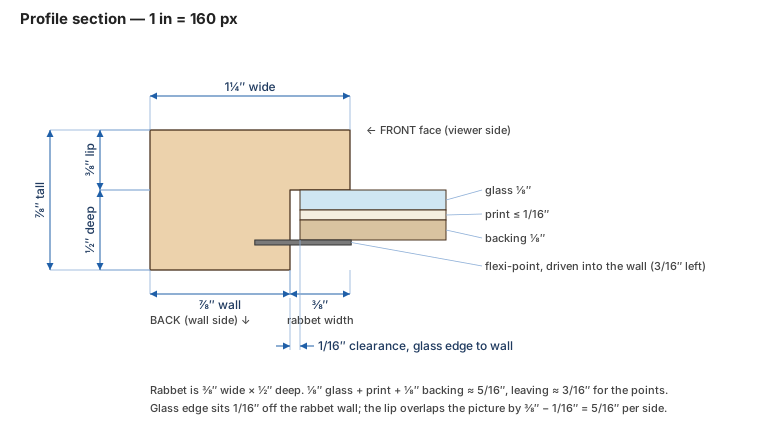
| Rabbet | ⅜″ wide × ½″ deep, cut on the back inside edge (chosen) |
| Glass-to-rabbet clearance | 1/16″ each side (chosen) |
| Joint | Four 45° miters |
Why that rabbet: ½″ deep holds ⅛″ glass + the print (≤ 1/16″) + a ⅛″ backing board ≈ 5/16″ and still leaves ≈ 3/16″ for the retaining points. That leaves a ⅜″-thick front lip on the ⅞″ stock. ⅜″ wide gives the lip a 5/16″ overlap on the picture edge (⅜″ − 1/16″ clearance). That is enough to hide a ragged edge and hold the picture, and it leaves a ⅞″ wall behind it.
Drawings (true scale)
Drawn from the dimensions on this page. Click to open full size.
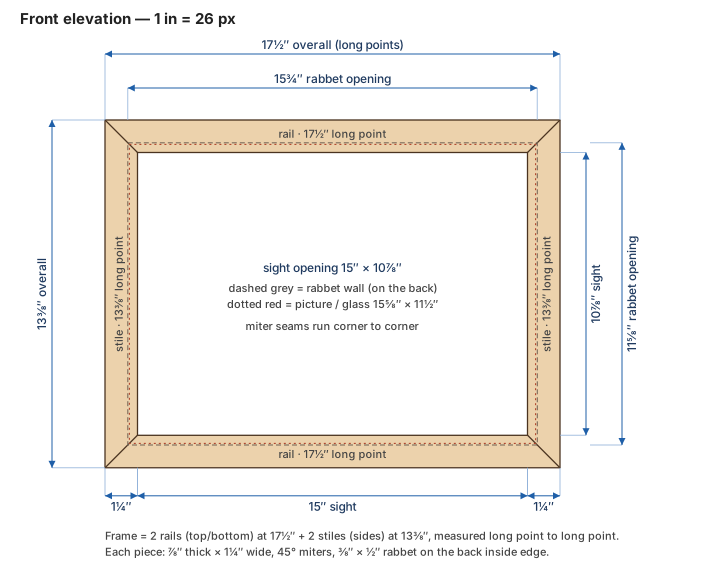
Front elevation
Profile section
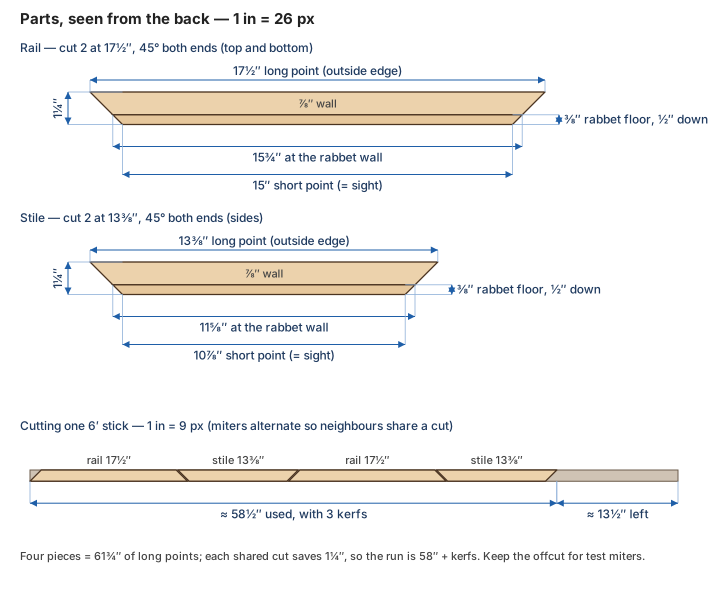
Parts and stick layout
The numbers
| Derived | Working | Result |
|---|---|---|
| Rabbet opening | picture + 2 × 1/16″ | 15¾″ × 11⅝″ (derived) |
| Sight opening (what you see) | rabbet opening − 2 × ⅜″ | 15″ × 10⅞″ (derived) |
| Outside size | sight + 2 × 1¼″ | 17½″ × 13⅜″ (derived) |
| Visible face width | stock width | 1¼″ all round |
| Picture hidden under the lip | ⅜″ − 1/16″ | 5/16″ per side |
| Rabbet-opening diagonals (square check) | √(15¾² + 11⅝²) | 19.58″, both equal |
Shortcut for any picture: every piece is cut to the picture dimension + 1⅞″, measured long point to long point. 15⅝″ + 1⅞″ = 17½″; 11½″ + 1⅞″ = 13⅜″.
Cut list
Finished stock is ⅞″ × 1¼″, rabbeted before mitering. Lengths are long point to long point.
| Part | Qty | T × W × L | Notes |
|---|---|---|---|
| Rails (top, bottom) | 2 | ⅞″ × 1¼″ × 17½″ | 45° at both ends, long point on the outside edge |
| Stiles (sides) | 2 | ⅞″ × 1¼″ × 13⅜″ | Same |
| Glass | 1 | ⅛″ × 11½″ × 15⅝″ | Ask the glass shop for exactly this size; acrylic works and is lighter |
| Backing board | 1 | ⅛″ × 11½″ × 15⅝″ | Hardboard, thin ply or foam-core |
| Retainers | 6–8 | Flexi-points or small turn buttons, about ⅛″ proud of the rabbet floor | |
| Hanger | 1 set | Two D-rings (screws ≤ ½″ long, since the wall is ⅞″ thick) + picture wire, or one sawtooth hanger for a light frame |
Stock to buy: the four pieces total 61¾″ of long-point length. Alternating the miters nests the pieces, so each shared cut saves 1¼″ and the stick only needs about 58½″ with kerfs (61¾″ − 3 × 1¼″ + 3 kerfs). Buy one 6′ length (5/4 stock milled to ⅞″ × 1¼″) so the corners share grain and about 13½″ is left for test cuts. Mill a little extra width for the rabbet setup pieces.
Build sequence
- Mill one straight stick to ⅞″ × 1¼″, longer than needed. Pick the best face as the front.
- Cut the rabbet first, on the whole stick: ⅜″ wide × ½″ deep on the back inside edge. Table-saw it in two passes, or use a router with a rabbeting bit. Test on an offcut: the leftover front lip should be ⅜″ thick.
- Ease the front edges with a light 1/16″ chamfer or sanding if you want. Do it now, while the stick is straight.
- Check the saw’s 45° with a square cut-off test: cut two scraps, join them, and measure against a 90° square. Fix it before cutting good stock.
- Cut the miters on a miter saw or sled with a stop block. Set the stop for 17½″ and cut both rails with the same setting, then reset to 13⅜″ for the stiles. Measure on the outside (long-point) edge, with the rabbet side up or down, but the same way each time.
- Dry-fit the four pieces. Check that the rabbet opening is 15¾″ × 11⅝″ and that its diagonals match at 19.58″. If they don’t, sneak up on the miters with a shooting board.
- Glue the miters. End grain drinks glue, so size each miter with a thin coat, wait a minute, then apply glue and clamp with a band or corner clamps. Check the diagonals again before it sets.
- Reinforce the corners, because a plain miter is a weak joint: ⅛″ splines (a contrasting wood looks good), loose tenons or at least a pair of 18-ga brads at each corner.
- Sand and finish before the glass goes in. Keep finish out of the rabbet where the glass sits.
- Assemble: glass, picture, backing, then the points or turn buttons. Fit the D-rings on the back of each stile about a third of the way down (the wall is ⅞″ thick, so use short screws) and run the wire.
Other picture sizes
| Picture (H × W) | Rabbet opening | Sight opening | Outside (H × W) | Rail / stile long point |
|---|---|---|---|---|
| 5″ × 7″ | 5⅛″ × 7⅛″ | 4⅜″ × 6⅜″ | 6⅞″ × 8⅞″ | 8⅞″ / 6⅞″ |
| 8″ × 10″ | 8⅛″ × 10⅛″ | 7⅜″ × 9⅜″ | 9⅞″ × 11⅞″ | 11⅞″ / 9⅞″ |
| 11″ × 14″ | 11⅛″ × 14⅛″ | 10⅜″ × 13⅜″ | 12⅞″ × 15⅞″ | 15⅞″ / 12⅞″ |
| 11½″ × 15⅝″ (this plan) | 11⅝″ × 15¾″ | 10⅞″ × 15″ | 13⅜″ × 17½″ | 17½″ / 13⅜″ |
Here rails are the long top and bottom pieces, and stiles are the shorter sides. With a mat, use the mat’s outside size as the “picture”.
Alternate rabbet
If a ⅜″-wide rabbet hides too much of the picture, a ¼″ rabbet is fine (the stock is the same size). Everything shifts by +¼″: sight opening 15¼″ × 11⅛″, outside 17¾″ × 13⅝″, so rails become 17¾″ and stiles 13⅝″ (formula: picture + 2⅛″). The lip then overlaps the picture by only 3/16″ per side.
Open questions
- Rabbet size is my choice, not part of your profile. If the profile you have in mind already includes a rabbet or a decorative bevel on the front, tell me and I’ll redo the numbers.
- Mat or no mat: if the picture is to be matted, the “picture” in every formula is the mat’s outside size, and the glass is cut to that.
- Print thickness: a thick print or a stretched canvas needs a deeper rabbet. ½″ allows about 5/16″ of glass + print + backing.
- Hanging weight: the D-ring setup suits anything up to the 5–10 lb range. A frame this size with glass weighs about 2–3 lb.