Salamanders of Western North Carolina
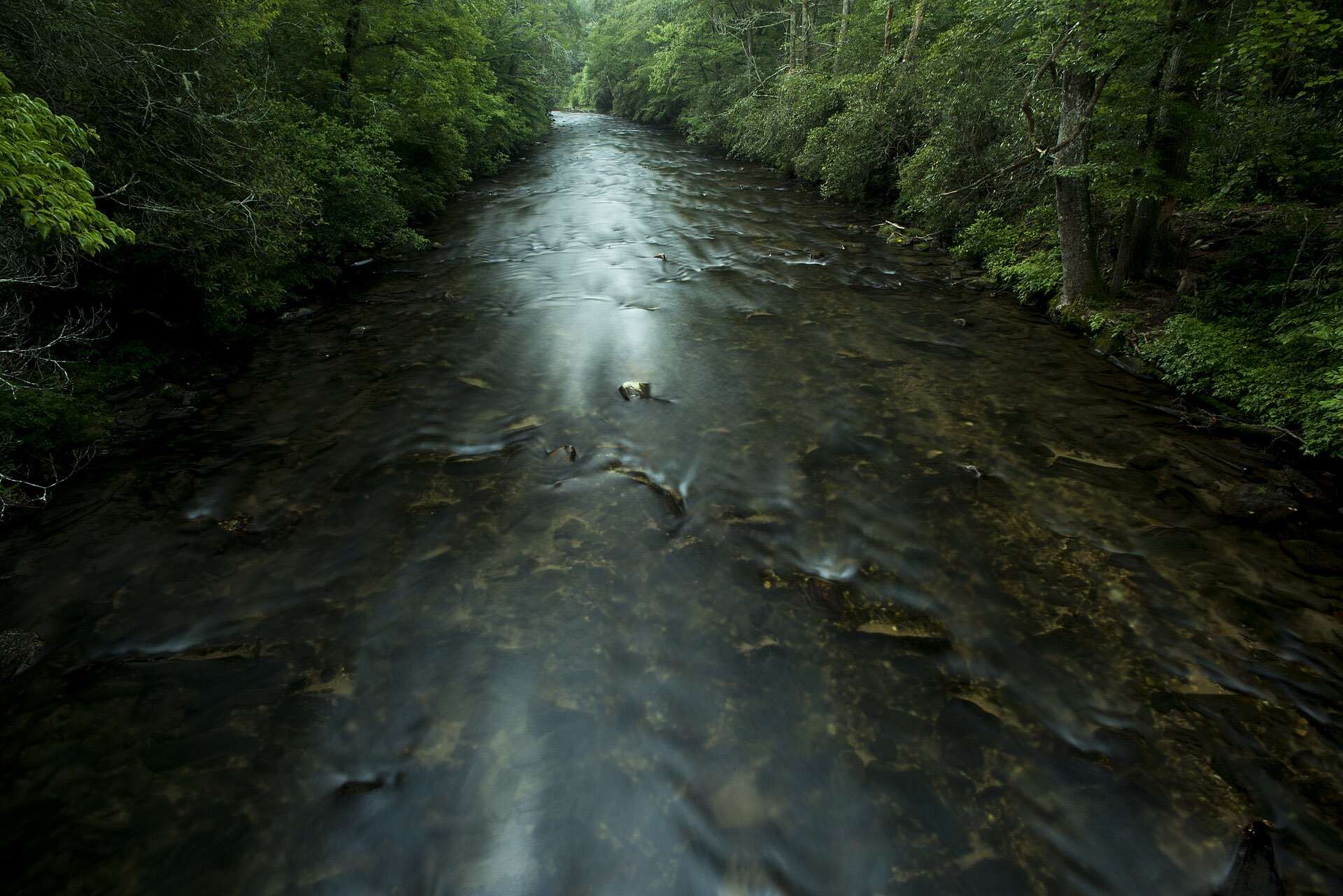
A dark, clear mountain river running under a closed hardwood canopy

Davidson River, Pisgah National Forest, Transylvania County

Salamanders of Western North Carolina

The Southern Blue Ridge holds more salamander species than any comparable area on Earth. This is a working reference to them: current names, where each lives along the stream-to-ridge gradient, which mountain blocks hold which taxa, and where each stands legally as of October 2026.

    Why here

    AmphibiaWeb currently recognizes 846 salamander species worldwide, and 523 of them (62%) belong to Plethodontidae, the lungless salamanders. The 56 species treated on this page, 51 of them plethodontids, occur in roughly two dozen mountain counties. That is about one in fifteen of the world’s salamanders and one in ten of its plethodontids.

    Lunglessness is the key. Plethodontids breathe through moist skin and the lining of the mouth, so they need cool, wet, thermally stable habitats, and the Southern Blue Ridge supplies them at every elevation. High, isolated ridges separated by warm valleys fragment those habitats. Climatic-niche evolution here has been fast (Kozak & Wiens 2010), and much of the Plethodon radiation is non-adaptive: similar species sorted onto different mountain blocks rather than into different niches.

    The region has never been glaciated, and it has been a center of plethodontid diversification since long before the Pleistocene. Many lineages here are old, narrowly distributed, and only recently recognized as species.

    Species treated on this page, by family

      The names have changed. Between 2020 and 2023, Pyron, Beamer and colleagues revised nearly every Southern Appalachian Desmognathus complex. D. quadramaculatus is no longer a valid name: Holbrook’s type proved to be a dusky salamander, so the name falls into the synonymy of D. fuscus. The black-bellied, shovel-nosed, Ocoee, seal and dusky complexes now account for more than a dozen species in WNC alone. The SSAR 9th edition (2025) adopts all of these changes. Older field guides, the NC Herp Atlas and some state databases still use the earlier names, so each species account here lists what it was formerly called.

      Not treated as WNC species here, pending vouchers or confirmation: D. aureatus (“small portions of nearby NC”; a related mtDNA lineage has been found in the Smokies), D. conanti s.s. (“likely” in extreme western NC), D. planiceps (confirmed only in the NC Piedmont), D. kanawha (upper Yadkin and Roanoke; New River headwaters inferred), P. glutinosus s.s. (older NC records belong to segregate species), Ambystoma jeffersonianum (known from adjacent Virginia only), and A. talpoideum.

      From the channel to the ridgeline

      Each bar is the approximate elevational range a species occupies in Western North Carolina. Grouped by microhabitat, the chart reads like a hillside: big aquatic species at the bottom, the streamside Desmognathus ladder in the middle, and the terrestrial Plethodon on the slopes and summits. Colored bars carry NC protected status. Select a species to open its account.

      • Not state listed
      • NC Special Concern
      • NC Threatened
      • NC Endangered
      • Background: approximate forest zone

      Elevations are generalized from regional accounts and vary with aspect, latitude and local relief; treat them as a guide to where to look, not as range limits. How these were derived.

      The Desmognathus ladder

      Walk a transect up from a Blue Ridge stream and the dusky salamanders change in a predictable order. First come the shovel-nosed species in the riffles, then the black-bellied species at the channel edge and seal salamanders on the banks. The duskies hold the seeps. The mountain duskies (ocoee, carolinensis, orestes, imitator and relatives) range out onto the forest floor, and the pygmy and seepage salamanders, which develop directly, live in the litter well away from water. Body size, age at maturity and fecundity fall along the same gradient (Hairston 1949; Bruce 1996, 2013).

      The phylogeny complicates the tidy picture. The shovel-nosed form evolved at least twice, once in the Nantahala clade (aureatus with folkertsi) and once in the Pisgah clade (intermedius). The black-bellied form also spans two distant clades. Ecomorphs that look like a single adaptive radiation are partly repeated convergence, possibly helped by ancient introgression (Kozak et al. 2005; Pyron & Beamer 2023).

      Hairston’s salamanders

      In the Smokies, Plethodon jordani holds the high slopes and the large slimy salamander (P. glutinosus then, P. teyahalee now) the lower ones, with a narrow band of overlap. In the Balsams the overlap is wide (Hairston 1951). Removal experiments in both ranges found competition much stronger in the Smokies (Hairston 1980). Reciprocal transplants were asymmetric, and the evolved response was interference, through aggression, rather than partitioning of food or microhabitat (Hairston, Nishikawa & Stenhouse 1987). Under current taxonomy, Hairston’s Balsam “jordani” are probably P. metcalfi.

      In the Nantahalas, P. shermani and P. teyahalee meet in an elevational hybrid zone (Hairston et al. 1992). Reanalysis of 16 years of Coweeta data found that the zone moved upslope and the share of pure shermani at high elevation fell as mean annual temperature rose (Walls 2009). Resurveys of Hairston’s 1940s transects found something less expected: montane species’ lower limits moved down as forests recovered (Moskwik 2014).

      Mountain blocks and drainages

      Narrow-range Southern Appalachian salamanders sort by isolated high-elevation blocks and by the Eastern Continental Divide. The matrix shows which species occur in each block; the diagram below shows which side of the divide each river runs to.

      • Present
      • Marginal, peripheral, or only at the edge of the block

      Blocks are coarse, and boundaries between them are drawn for this chart. Distributions are summarized from Beane et al. (2010), species descriptions and recent revisions; check the primary literature for locality-level questions.

      Schematic of Western North Carolina river basins on either side of the Eastern Continental Divide Eastern Continental Divide West of the divide: Mississippi basin Hellbender and mudpuppy range Hiwassee Little Tennessee French Broad incl. Pigeon, Nolichucky headwaters Watauga New to the Ohio via the Kanawha East of the divide: Atlantic slope No hellbenders; Blue Ridge Escarpment gorges hold the green salamander complex Savannah Chattooga, Horsepasture Broad Hickory Nut Gorge, Green River Catawba Linville Gorge, South Mountains Yadkin–Pee Dee
      Schematic only; not to scale. The French Broad, Little Tennessee and Hiwassee rise on the Atlantic-facing Blue Ridge front and cut west through the mountains, so the divide sits close to the escarpment across most of the region.

      The eastern hellbender

      Cryptobranchus alleganiensis alleganiensis (Sonnini de Manoncourt & Latreille, 1801) is North America’s largest salamander and the region’s indicator of a working river. In North Carolina it lives only in the Tennessee and New River drainages, and more than half of the occupied reaches fall within Hurricane Helene’s September 2024 flood extent. Phylogeographic work recovers several deep lineages. The New–Kanawha animals of northwestern North Carolina belong to one that has no name yet (Hime 2017; SSAR 2025).

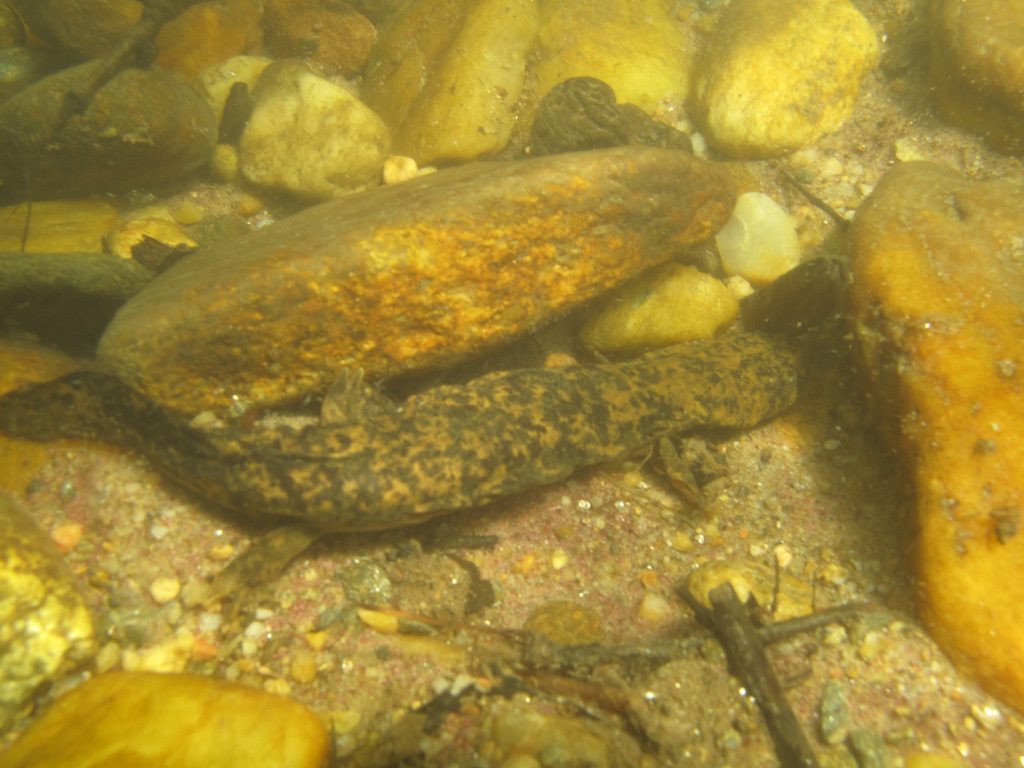
      An eastern hellbender resting on a gravel and cobble stream bed, seen underwater
      Flattened head, lateral skin folds, tiny lidless eyes. Photo: Gary Peeples, USFWS.
      Size
      Adults typically 40–45 cm total length; can exceed 60 cm and 1.4 kg
      Maturity
      About 5–8 years, at roughly 30 cm
      Longevity
      At least 25–30 years in the wild
      Respiration
      Mostly cutaneous; the wrinkled lateral folds add surface area. Adults have lungs but use them little.
      Breeding (NC)
      Late August through September. External fertilization in a cavity under a large rock.
      Clutch
      200–500 eggs in strands, about 6 mm each; hatch in 10–12 weeks
      Larvae
      Keep external gills for about 1.5–2 years; use unembedded cobble and gravel interstices
      Diet
      Mostly crayfish; also small fish, insects, frogs, and carrion
      Home range
      About 30–2,212 m²; individual movements up to 12.9 km recorded

      Sources: NCWRC species profile; USFWS proposed rule, 89 FR 100934 (13 Dec 2024).

      Habitat

      Perennial, swift, cool, well-oxygenated, low-conductivity streams and rivers, usually below about 900 m in North Carolina. Adults need large, flat, partly embedded rocks (at least 30 cm across) with a single downstream-facing opening, and suitable patches no more than about a kilometre apart without barriers. In Pennsylvania, specific conductance was the strongest single predictor of persistence (Pitt et al. 2017).

      The denmaster

      The male excavates a nest cavity, admits one or more females, then guards the clutch and larvae for months. Cameras on the French Broad in 2018–19 showed resident males spending 82% of recorded time at the entrance and driving off other hellbenders (Unger et al. 2020). Guarding males also eat eggs, and whole-clutch filial cannibalism increases with upstream forest loss: in 182 nests across 10 Virginia sites, nest failure rose as riparian forest cover fell (Hopkins et al. 2023).

      What is pushing them down

      USFWS ranks sedimentation first, followed by water quality, impoundments and channelization, disease, collection and persecution, small isolated populations, and climate change. In Western North Carolina, occupancy at headwater sites tracks both land cover and local physicochemistry (Pugh et al. 2016). Moving rocks also kills them: in-stream rock moving and dam-building have killed adults and larvae (Unger et al. 2017), and in September 2025 Great Smoky Mountains National Park reported a hellbender crushed under a visitor-built rock stack.

      Range-wide, the 2024 proposal counts 626 historical populations. Of those, 371 are extant and 255 (41%) are extirpated or functionally extirpated. Of the extant populations, 218 (59%) are declining and only 45 (12%) are stable and recruiting.

      Federal listing history

      1. CBD petitions to list 404 southeastern aquatic species, the hellbender among them.
      2. Ozark hellbender (C. a. bishopi) listed Endangered; both subspecies added to CITES Appendix III.
      3. Range-wide listing of the eastern hellbender found not warranted; Missouri DPS proposed Endangered (84 FR 13223).
      4. Missouri DPS listed Endangered (86 FR 13465). It does not occur in NC.
      5. CBD v. USFWS (S.D.N.Y.) vacates and remands the 2019 finding for relying on conservation measures not yet implemented or shown effective.
      6. Eastern hellbender proposed Endangered range-wide; critical habitat ruled “not prudent” because maps would aid collectors (89 FR 100934).
      7. Statutory deadline for a final rule passes; USFWS moves the action to its long-term list.
      8. CBD sues in D. Ariz. (No. 4:26-cv-00093) to compel a final rule. As of October 2026 no ruling or settlement has been reported.

      After Helene

      Hurricane Helene hit in late September 2024, during peak nesting. Of the 49 hellbender-occupied stream segments in Western North Carolina, 28 overlap the mapped flood extent, 22 overlap failed infrastructure and 12 overlap landslides. At two Nolichucky sites, fine sediment rose from pre-storm averages of 26% and 21% to 35% and 41% (Southeast CASC final report, July 2026).

      In the second quarter of 2026, NCWRC surveys on an upper French Broad tributary in Transylvania County found adults still below pre-storm numbers but larvae at two of three sites. Substrate there worsened after in-stream debris removal.

      Who is working on it

      NCWRC has run hellbender inventory and monitoring since 2007 and an eDNA program that found the species at nine previously unrecorded sites in its first season (Spear et al. 2015). The NC Zoo surveys monthly with NCWRC and has tested concrete nest boxes north of Asheville since 2017. The Amphibian and Reptile Conservancy has an Asheville-based Hellbender Recovery Coordinator, and the Watauga Riverkeeper and MountainTrue relocated animals ahead of the Shull’s Mill dam removal.

      Report a hellbender or mudpuppy: NCWRC Western Region Amphibian Biologist, [email protected], or the NC Wildlife Helpline at 866-318-2401. A photo and the stream name are enough. Leave the animal and its rock where they are.

      Species accounts

      Every species on this page, in taxonomic order. Filter by family, microhabitat, drainage or status, or search by scientific name, common name, or an older name.

        Conservation status

        North Carolina’s protected-animal list is 15A NCAC 10I .0103–.0105, readopted 1 October 2021 and amended 1 February 2023 and 1 October 2024. An amendment opened for comment on 1 September 2026, with comments due by 2 November 2026; it does not change any amphibian entry. The ranks below come from the NC Natural Heritage Program’s 2024 rare animal list.

        TaxonNC legal statusFederal (ESA)NatureServe G / NC S rankIUCNNotes

        Species ranked or watch-listed by NCNHP but without legal status are included where the rank is S1–S3. NCNHP watch-list codes carry no legal protection. IUCN categories are from the most recent assessment found; several date from 2004 and are overdue for review.

        Batrachochytrium salamandrivorans

        Bsal has not been detected in North America; a national survey of 11,189 samples from 594 sites found none (Waddle et al. 2020). Risk models rank the Southern Appalachians among the three most vulnerable US regions (Richgels et al. 2016). The Lacey Act injurious-wildlife listing grew from 20 genera in 2016 to 36 in January 2025 (90 FR 2170). The list now includes the native genera Cryptobranchus, Desmognathus, Eurycea, Aneides, Pseudotriton and Ambystoma. Live shipment within the continental US is not barred (USARK v. Zinke, 2017), so the pet trade remains the main pathway.

        Bd and ranavirus

        B. dendrobatidis is confirmed in North Carolina hellbenders. In the Smokies, only 1 of 665 Plethodon swabs tested positive in 2009, even though counts had fallen at 22 of 35 historic sites, which argues against Bd as the driver of those declines (Caruso & Lips 2013). Bd and ranavirus co-infection has been recorded in East Tennessee hellbenders (Souza et al. 2012).

        Climate and the summits

        Bioclimatic models project that much of the Appalachian Highlands’ salamander climate space will be lost by 2080 (Milanovich et al. 2010). Museum series from 1957–2012 show adults about 8% smaller after 1980 (Caruso et al. 2014), though alternative explanations have been argued (Connette et al. 2015). Resurveys of Hairston’s 1940s transects found montane species’ lower limits moving down as forests regrew (Moskwik 2014). Simple upslope-retreat models do not capture that.

        Collection, rocks and storms

        Collection is a documented concern for crevice-dwelling green salamanders; a screwdriver found wedged in a Jackson County crevice was read as evidence of pet collecting. After Helene, 25 Hickory Nut Gorge green salamanders were rescued into a captive program at the NC Zoo, from a pre-storm population estimated at 200–500. Rock stacking and in-stream rock moving kill hellbenders and stream Desmognathus.

        Brevard, DuPont and the Parkway

        Three well-visited places within an hour of Brevard that between them cover nearly the whole gradient on this page, from escarpment gorges and granite-dome bogs to spruce–fir above 1,800 m. Many sites are still recovering from Hurricane Helene; conditions below are as of 1 November 2026. No sensitive localities are given.

        The Davidson River under a closed hardwood canopy
        Davidson River, Pisgah Ranger District. Photo: Lance Cheung, USDA.

        Brevard and Transylvania County

        Transylvania County straddles the Eastern Continental Divide where it runs along the Blue Ridge Escarpment. NCNHP singles out the Escarpment Gorges as having the highest rainfall in eastern North America. Research-grade iNaturalist records alone cover 25 salamander taxa in the county. The most-observed are the red-spotted newt, P. metcalfi, E. wilderae, P. ruber and D. monticola, followed by the NC-endemic D. balsameus on the Great Balsam front.

        It is the only Western North Carolina county known to hold D. campi, in upper French Broad headwaters. Hellbenders persist in upper French Broad tributaries; NCWRC surveys there in 2026 found larvae, but adults still below pre-Helene numbers. Green salamanders occur on the escarpment, and no sites are given here.

        Hairston described P. oconaluftee (now P. teyahalee) in 1993 from a holotype collected in the county, beside FS 140 near the North Fork of the French Broad, from a hybrid population on the Balsam front. C. S. Brimley collected E. wilderae at Blantyre in 1908.

        Access
        On the Pisgah Ranger District, Courthouse Creek Road (FS 140) and Pilot Mountain Road (FS 229) are closed, and Yellow Gap Road (FS 1206) is closed from Wolf Ford to North Mills River (USFS, 1 Oct 2026). Gorges State Park reopened only in part after the storm.
        Learning
        The NCWRC Pisgah Center for Wildlife Education was flooded by Tropical Storm Fred in 2021, and its education building will not be rebuilt. Hatchery redevelopment with interpretive signage runs through 2027. The Pink Beds wetlands at the Cradle of Forestry are an NCNHP significant area; the Cradle is closed until April. Highlands Biological Station’s Nature Center is closed for repairs through the end of 2026, but its gardens and trails are open.
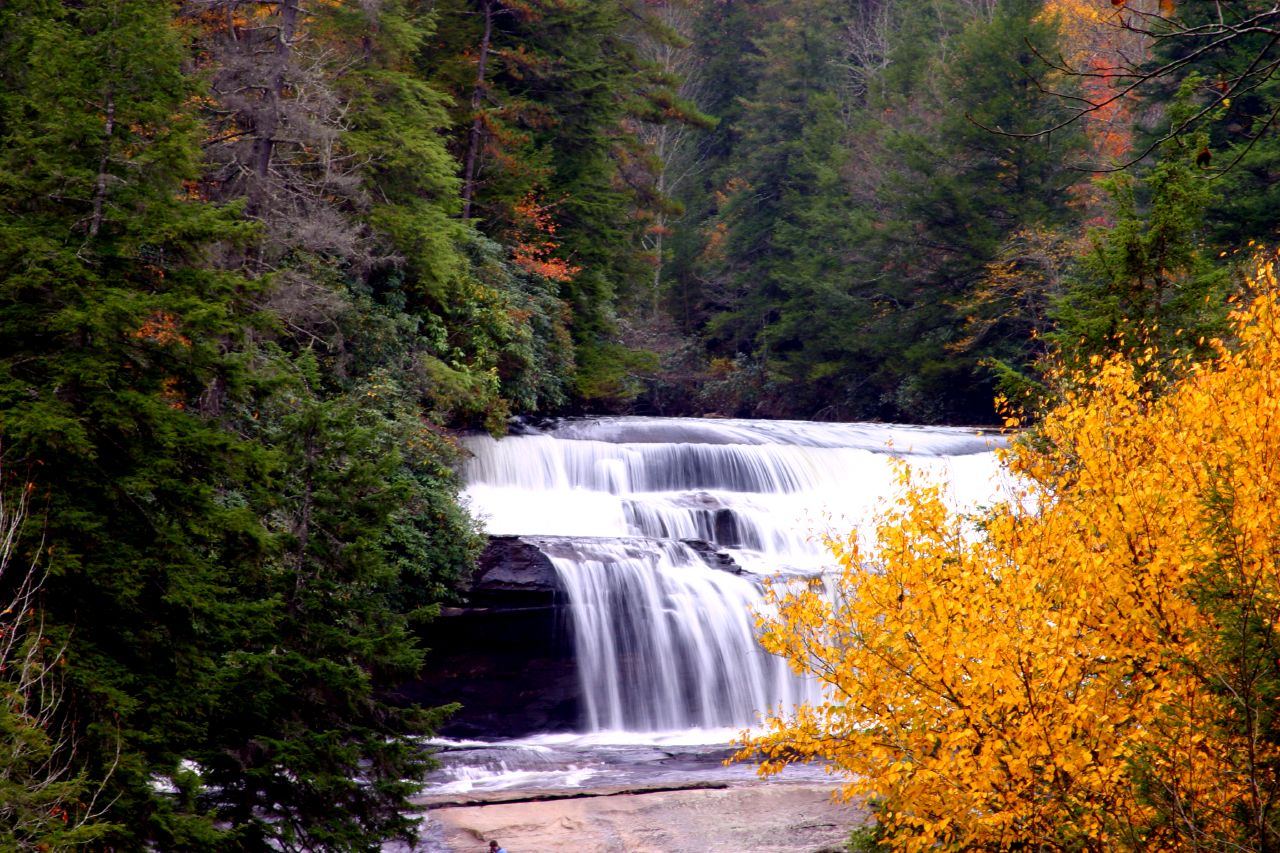
        Triple Falls cascading over granite ledges, framed by autumn foliage
        Triple Falls on the Little River. Photo: Gary Stevens, CC BY 2.0.

        DuPont State Recreational Forest

        About 12,500 acres of NC Forest Service land on the Transylvania–Henderson line, with more than a million visits a year. It is a state forest, not a state park, so different rules apply. The Little River drops over Hooker, Triple, High and Bridal Veil Falls, and Stone Mountain and Cedar Rock are exposed granite domes. NCNHP notes Southern Appalachian bogs and swamp forest–bog complexes in the Buck Forest area. Hemlock treatment began here in 2007, the first on NC Forest Service land.

        No published herpetofaunal inventory of DuPont turned up. Research-grade iNaturalist records list 11 salamander species, dominated by red efts, then P. metcalfi, P. ruber, E. guttolineata, A. maculatum and D. amphileucus. A single D. carolinensis record falls outside that species’ range and is probably misidentified. A forest with this many visitors and this much seep and bog habitat is an open opportunity for a systematic survey.

        Permits
        State forest rule 02 NCAC 60B .1028 bars collecting animals, plants or rocks without a permit from the Forest Supervisor. DuPont’s permits page has no research category, so contact the forest office ([email protected], 828-877-6527) in addition to getting your NCWRC license. Parts of the forest are game lands. Wading is not allowed within 300 ft above any waterfall.
        Conditions
        Triple Falls Trail reopened in May 2025 after Helene scoured the lower trail. The Triple Falls stairs and Turkey Knob Trail bridge remain closed, and the High Falls kiosk-to-loop path closes 6 November 2026.
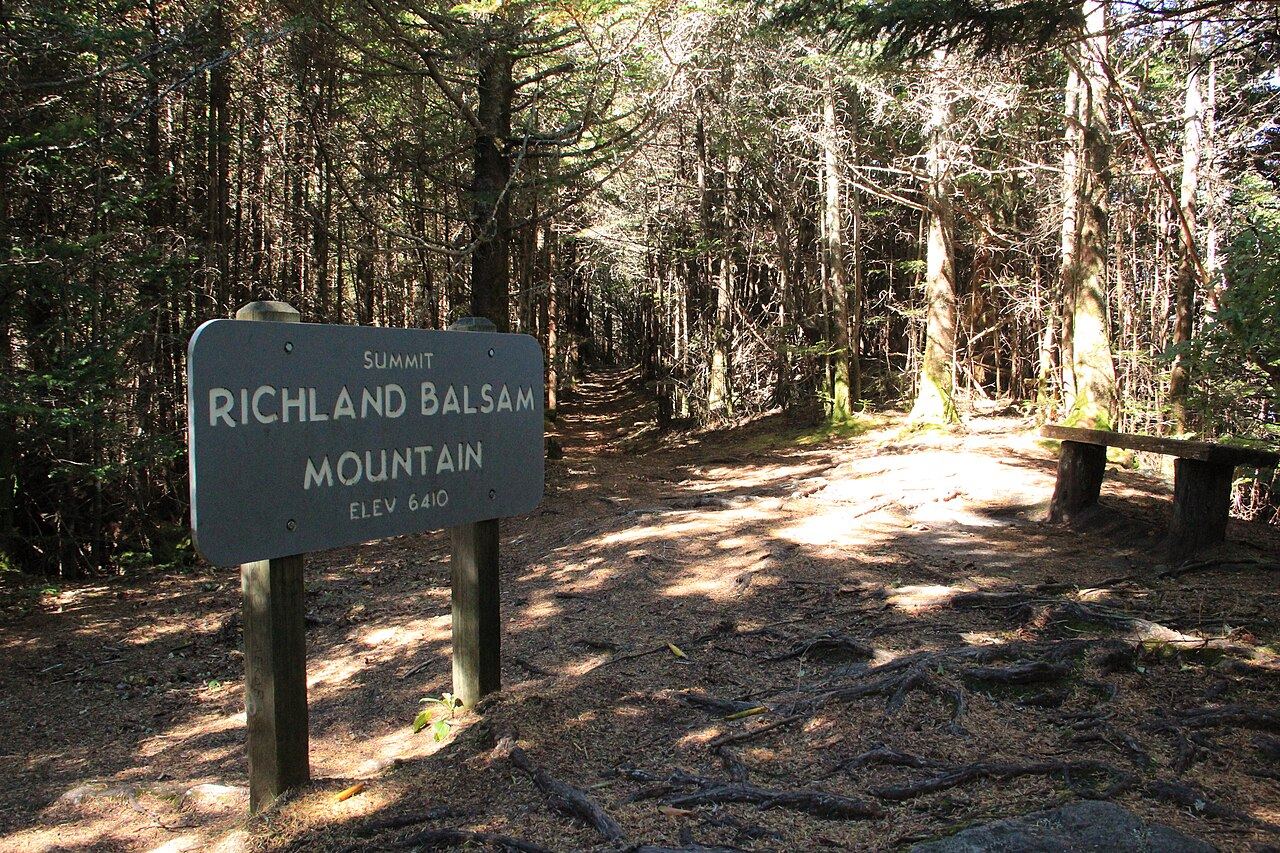
        Trail through dense spruce and fir at the Richland Balsam summit sign
        Spruce–fir at the Richland Balsam summit. Photo: Thomson200, CC0.

        Blue Ridge Parkway

        The Parkway’s 2018 checklist, covering Virginia and North Carolina, lists 43 salamander taxa (42 species) under pre-2022 names. The NPSpecies database lists 34. The only systematic herpetofaunal inventory found is Hays & Hays (2006), from fieldwork in 2003–04, and no ongoing Parkway salamander monitoring turned up. The road threads most of the high blocks in the range matrix above.

        Waterrock Knob
        Milepost 451.2. NCNHP tracks a distinct D. imitator population here (S1?, G3G4T1Q), on wet rock faces at about 1,650–1,800 m close to a heavily used road. Excluded from special-use and commercial permits.
        Richland Balsam
        Milepost 431.4. The overlook is the Parkway’s high point at 6,053 ft, in red spruce and Fraser fir damaged by balsam woolly adelgid. This is Great Balsams spruce–fir, the country of D. wrighti, D. balsameus and P. metcalfi.
        Graveyard Fields
        Milepost 418.8, on Pisgah Ranger District land. Camping is prohibited.
        Craggy Gardens
        Milepost 364. iNaturalist records are dominated by D. carolinensis and P. montanus. NCNHP notes old-growth stands in the Craggies, and off-trail travel on Craggy Pinnacle is prohibited.
        Mount Mitchell
        The state park reopened in September 2025, reached from the Asheville side. D. carolinensis is the most-recorded species. The Black Mountains hold D. organi and P. welleri.
        Grandfather Mountain
        Type locality of P. welleri, of D. marmoratus (south flank, about 1,070 m), and of D. mavrokoilius (Dixon Creek, Caldwell County). The state park’s Profile Trail partly reopened in June 2026.

        Rules: 36 CFR 2.1 bars disturbing wildlife on the Parkway. Research and collecting permits go through RPRS and are issued only to institutional or agency representatives. All Parkway waters are closed to swimming, and off-trail travel is prohibited on the Tanawha Trail and Craggy Pinnacle. As of 31 October 2026, milepost 344.2–355.3 (NC 80 to Mount Mitchell) is closed, with all recreation prohibited. NPS is targeting full reopening by the end of 2026, and trail repairs follow the road work. Visitor centers other than the main one at milepost 384 are typically open May to October.

        Working in the field

        Western North Carolina is a patchwork of national park, national forest, state, tribal and private land, and each needs its own permission on top of the state license.

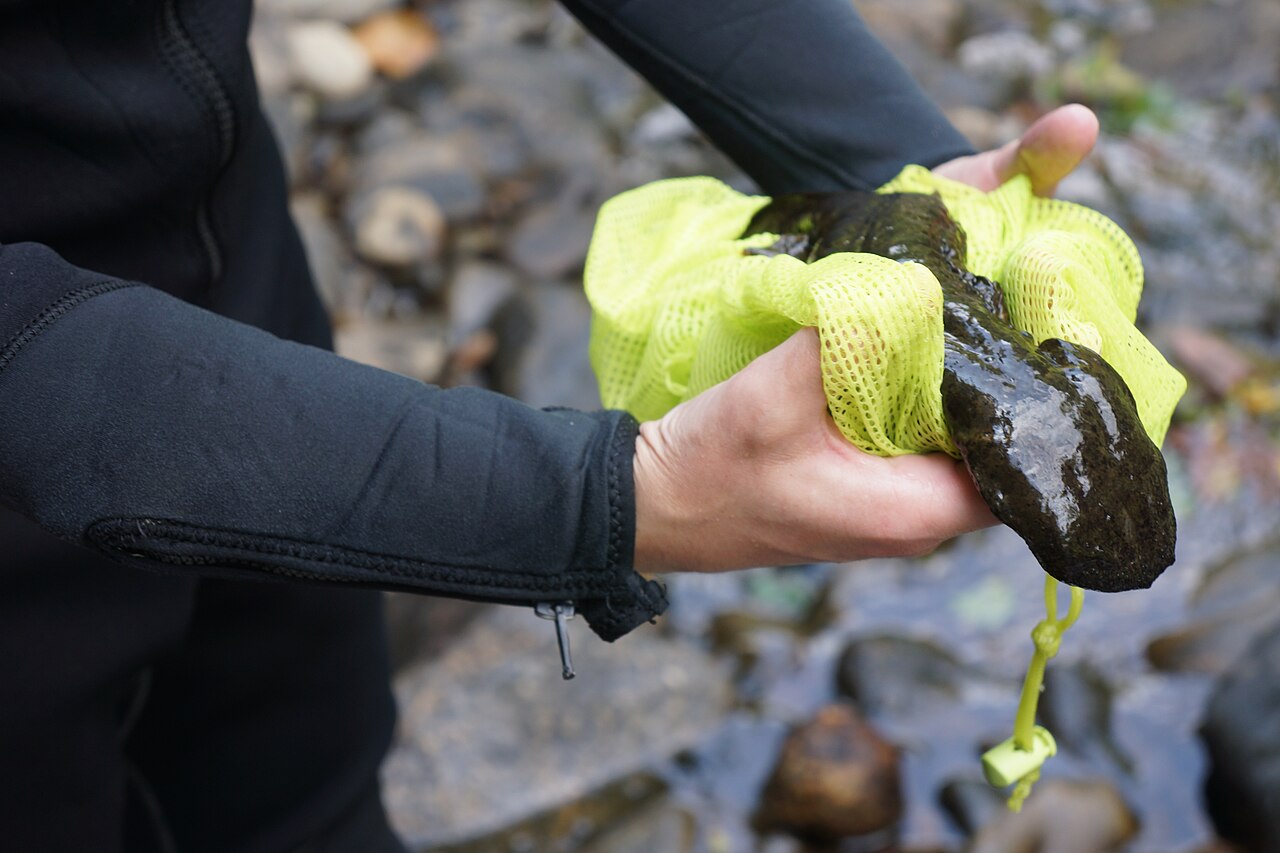
        A survey biologist holding an eastern hellbender in a mesh net beside a mountain stream
        Hellbender in hand during a 2013 multi-agency survey of NC mountain streams. Photo: Gary Peeples, USFWS.

        Permits

        NCWRC collection license
        Scientific Wildlife Collection License through Go Outdoors NC. Apply at least three months ahead with a research proposal and IACUC approval where applicable. It is renewed every year and expires 31 December. NCWRC
        NCWRC endangered species permit
        Required in addition to the license for any E, T or SC species, including hellbender, mudpuppy and both green salamanders. Data must be reported before renewal.
        Smokies and Blue Ridge Parkway
        NPS Research Permit and Reporting System (irma.nps.gov/RPRS); collecting falls under 36 CFR 2.5.
        NC State Parks
        Research Activity Permit for any research, including Chimney Rock, Gorges, Grandfather Mountain, Mount Mitchell and South Mountains.
        National Forests in NC
        No research-permit page was found; contact the ranger district (Pisgah, Grandfather, Appalachian, Nantahala, Cheoah, Tusquitee). Removing minerals for science needs a permit. Visitors may collect small amounts of surface rock (up to about 10 lb) but may not dig. Do not move stream rocks: it destroys hellbender and salamander cover.
        Qualla Boundary
        Eastern Band of Cherokee Indians lands need tribal authorization.

        Decontamination

        Follow the Northeast and national PARC guidance (Bletz et al. 2023, Herpetological Review 54:200–203), which is set to kill Bsal, not just Bd. Use one of these, and allow five minutes of contact in the field:

        • Virkon Aquatic at 1%, 2 minutes minimum.
        • Sodium hypochlorite at 1.6%, 5 minutes. That is about 7 cups of 5.25% household bleach per gallon, roughly ten times the old Bd-only strength.
        • Ethanol at 70%, 1 minute, for calipers and small tools.

        Mix and use bleach at least 50 m from water. Change gloves between animals, and bag animals separately.

        Rocks, nests and locations

        • Leave known or likely hellbender nest rocks alone from August through December (nesting starts late August; eggs take 10–12 weeks). Use snorkel surveys, cameras, eDNA or nest boxes instead. Any rock you lift goes back exactly as it was, ideally with the animal released beside it rather than underneath.
        • Do not publish point localities for green salamanders, hellbenders, Weller’s or the narrow endemics. NCNHP data terms require sensitive records to be generalized. iNaturalist obscures to a 0.2° cell, but open records nearby can give the site away.
        • Follow the ASIH/HL/SSAR Guidelines for Use of Live Amphibians and Reptiles in Field and Laboratory Research.

        Long-term sites

        Highlands Biological Station, administered by Western Carolina University, has hosted plethodontid research for generations (Bruce 2017 gives the history). Coweeta Hydrologic Laboratory in Macon County has been an experimental forest since 1934 and an LTER site from 1980 to 2020. The Smokies’ All Taxa Biodiversity Inventory, run with Discover Life in America, produced the first new vertebrate from that inventory, Desmognathus gvnigeusgwotli, described in 2022.

        References

        Primary literature, regulatory actions and agency sources behind this page. The methods and re-run workbook covers how they were gathered and reconciled, what remains unverified, and how to update the page.