Rod 002: 6'6" 2pc Light Spinning (French Broad)
A two-piece split-cane spinning rod for winter fishing on the French Broad around Hap Simpson Park in Brevard, late November through December. The joint is a spliced (scarf) joint, with a ferrule as the fallback, and both sections are milled on the standard Morgan Hand Mill bed. This is my first spinning rod, so the page also covers the spinning basics a fly-rod builder doesn’t already know: power classes, the reel seat, guides, the reel, and lures.
The spec in one line: 6’6”, two piece (splice or 12/64 ferrule), hex, light power / moderate-fast action, 4–6 lb line, lures 1/16–1/4 oz (designed around 1/8 oz), sliding-ring cork grip, a 1000-size reel.
Status: design only. The taper below hasn’t been cut yet. It’s been checked against the library’s spinning rods in caneDNA (see Taper). A review on 2026-11-02 found the lower third runs stiffer than the reference rods; a trimmed variant E is proposed but not adopted.
The water: French Broad at Hap Simpson, Nov–Dec
Section titled “The water: French Broad at Hap Simpson, Nov–Dec”- Where: Hap Simpson Park is a City of Brevard river access with a boat ramp and picnic tables, at about mile 21.5 of the French Broad Paddle Trail. It’s the take-out for the flat, calm ~10-mile float down from Island Ford. The Pisgah Forest access is about 5 miles downstream.
- What it’s like: The mainstem here is slow, sandy, deep-bend water, not freestone pocket water. In winter, fish hold in the deep slow pools, on the outside bends, and around woody cover. Expect holdover stocked trout and resident browns, plus smallmouth, redbreast sunfish and rock bass, all sluggish in cold water.
- Regulations (verify before fishing): A third-party county guide lists the mainstem from the West/North Fork junction down to the US 276 bridge as Hatchery Supported trout water. That reach should include Hap Simpson, but I haven’t confirmed it against the NCWRC rule text. Under Hatchery Supported rules: 7 trout/day, no minimum length, and no bait or lure restrictions. You need an NC fishing license plus the trout privilege on designated public mountain trout waters.
- Best fishing nearby in this window: The fresh fish are in the Delayed Harvest waters. These are the East Fork French Broad (NCWRC scheduled its fall 2026 stocking for Nov 10 after warm water cancelled October) and DuPont’s Little River. DH runs catch-and-release, artificial lures with one single hook only. Build the tackle box around single-hook lures and one kit covers both waters (see Tackle).
- Stocking caveat: Bobby N. Setzer hatchery, right up the Davidson, closed in late 2025 for renovation, so NCWRC now stocks from Armstrong. Check the NCWRC stocking schedule instead of assuming past patterns.
- Flows: USGS 03443000, French Broad at Blantyre is the closest mainstem gage below Brevard.
The Brevard / DuPont / Highlands dossier has the rest of the region: shops, the DH calendar, and Helene access notes.
Power class: ultralight vs. light
Section titled “Power class: ultralight vs. light”Spinning rods are rated by power (how much force it takes to bend the rod; roughly, the line and lure weights it handles) and action (where it bends: fast = mostly the tip, moderate = into the middle). This is the spinning equivalent of a fly rod’s line weight.
| Class | Line | Lures | Good for | Here |
|---|---|---|---|---|
| Ultralight (UL) | 2–4 lb | 1/32–1/8 oz | small creeks, small fish, short casts | Fits the East Fork and creeks. Underpowered for the mainstem’s width, current, and the odd big brown or smallmouth. |
| Light (L) | 4–6 lb | 1/16–1/4 oz | small rivers, stocked trout, bass | Pick this. It casts across the mainstem pools, handles a 1/4 oz spoon or jerkbait, and is still fun on a 10” stocker. |
| Medium-light (ML) | 6–8 lb | 1/8–3/8 oz | bigger rivers, bass-first fishing | Overgunned for winter’s small, slow lures. |
Light wins because this rod has to cover both the wide, slow mainstem and the small DH runs, and winter lures are small (1/16–1/8 oz) but sometimes need distance. A bamboo light rod still casts 1/16 oz well, because a cane rod’s own mass helps load it. Thomas & Thomas labeled their classic 5’6” spinner “ultralight,” and a builder who measured one rated it light-to-ultralight in the hand. That’s the feel I’m after here.
Rod spec
Section titled “Rod spec”| key | value |
|---|---|
| geometry | hex (6) |
| rod length | 6 ft 6 in (78”) |
| pieces | 2, joint at 39” (spliced, or a 12/64 ferrule) |
| power / action | light / moderate-fast |
| line | 4–6 lb mono |
| lure weight | 1/16–1/4 oz (design point 1/8 oz) |
| tip | 0.080” → tiptop tube 6/64 |
| butt (grip) | 0.279–0.281” (variant D; variant E is 0.262–0.264”) |
| handle | 12” full cork, two sliding rings |
| guides | 6 single-foot + tiptop (16 mm stripper) |
| strip length | ~50” per section (incl. splice overlap and cut-offs) |
Tiptop fit is tight. Across the corners, a 0.080” hex tip is 0.080 ÷ cos 30° = 0.0924”, against a 6/64 tube at 0.09375”, about 0.0013” of clearance. The tube also covers the first ~½” of the rod, where the taper is a little larger. Test-fit before wrapping and be ready to relieve the tip corners or step up to a 7/64 tube.
Two pieces: splice or ferrule
Section titled “Two pieces: splice or ferrule”The rod is two 39” sections, and the joint is chosen after glue-up: a spliced (scarf) joint or a 12/64 ferrule. Both sections fit the standard Morgan bed, so there’s no extension bed, no 89” strips, and no long heat-treating oven. The class routine (5–6’ culm sections, normal oven) applies as-is.
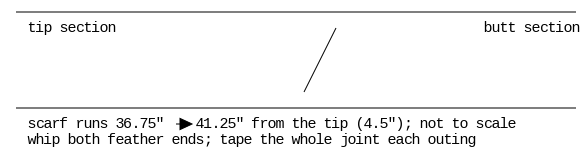
Mill both sections long through the joint. The tip section runs to about 44” from the tip, and the butt section starts at about 34”. That covers half a 4.5” splice on each side of 39”, plus cut-offs. Then pick the joint:
- Splice (preferred). Cut matching 4.5” scarf bevels (on the adjustable scarf jig, set to 1:23.3) on opposite faces, across the flats, from 36.75” to 41.25”. 4.5” is about 23 times the 0.193” dimension. Joined, the two bevels restore the full cross-section, so the rod bends like a one-piece and adds no weight. Whip each feather end with a few turns of thread so it can’t lift or split. At the river, lay the bevels together, line up the guides, and wrap the joint tightly with tape (cloth friction tape or self-amalgamating tape).
- Ferrule (fallback). Trim both sections square at 39” and fit a 12/64 ferrule. The 0.193” flats there are 12.4/64, the same fit as Rod 001’s 12/64 at 0.193”. It’s convenient, but on a light spinner the ferrule outweighs the lure: a 12/64 is roughly 0.2 oz (my estimate) against a 1/8 oz lure.
| Splice | 12/64 ferrule | |
|---|---|---|
| Weight at mid-rod | none | ~0.2 oz, more than the lure |
| Action (caneDNA) | same as a one-piece (the model ignores the tape) | butt works ~6–10% harder at 45–60” |
| Setup at the river | tape it, ~1 minute | push it together |
| Failure modes | feather edges chip if not whipped; align by eye | stiff spot ~2.5” long; ferrule fit |
Other notes:
- Culms and nodes: a 3×3 stagger per section, as in the class build. Keep nodes out of the scarf (36–42”), the top 6” (tiptop), and the reel-ring area.
- Guides near the joint: put one guide just outside each end of the splice. They double as alignment marks when you tape up.
No published taper matched the spec, so I designed this one from published bamboo spinning tapers on bamboorodmaking.com:
- Richard Tyree’s 6’ (lures to 1/4 oz): the closest match, tip 0.079
- the T&T Classic 5’6” (2–4 lb, to 1/4 oz): tip 0.072
- Paul H. Young’s 6’4” Spin-Caster: tip 0.096, a heavier tip
The starting point scaled Tyree’s rod to 78” with a nearly straight taper (~0.014–0.016” per 5” station). A tip at 0.080 follows Ian Kearney’s advice that a light open-face rod “needs to come down to closer to .075.” I then ran the taper through caneDNA, my RodDNA-style taper engine, and stiffened it +4% from 10” to 60”, with the tip left as-is. That’s the “variant D” in the table below.
| Inches from tip | Dimension (flats) | Notes |
|---|---|---|
| −5 | 0.076 | extension past the tiptop (cut off) |
| 0 | 0.080 | tiptop |
| 5 | 0.088 | |
| 10 | 0.104 | |
| 15 | 0.120 | |
| 20 | 0.136 | |
| 25 | 0.152 | |
| 30 | 0.167 | |
| 35 | 0.182 | |
| 39 | 0.193 | joint (splice center / 12/64 ferrule) |
| 40 | 0.196 | |
| 45 | 0.211 | |
| 50 | 0.226 | |
| 55 | 0.241 | |
| 60 | 0.257 | |
| 65 | 0.271 | |
| 66 | — | front of cork |
| 70 | 0.279 | under grip |
| 75 | 0.281 | under grip |
| 78 | 0.281 | butt |
caneDNA results
Section titled “caneDNA results”caneDNA uses RodDNA’s casting-load model. (The lure-stress and recovery numbers below carry the caveats listed after the table.) I compared this taper against the 16 bamboo spinning rods in its library, including “Spin Rod 6’ 1 pc.”, which is essentially Tyree’s 6’. For the lures, each lure was modeled as a weight at the tip with a 4× impact factor. Stress is averaged from 10” to the grip; lower stress means a stiffer rod.
| Taper | Stress @ 1/16 oz | @ 1/8 oz | @ 1/4 oz | Recovery (RodDNA load) |
|---|---|---|---|---|
| First draft (straight Tyree scale-up) | 54k | 67k | 92k | 1.87 Hz |
| Variant D (this taper) | 51k | 63k | 87k | 2.00 Hz (75” taper) |
| Tyree 6’ 1pc (reference) | 52k | 65k | 91k | 2.42 Hz (60” taper; not like for like) |
- Stress level: per lure weight, the rod loads like Tyree’s proven 6’. It sits between the ultralight T&T (higher stress) and the 6–10 lb 7’ spinners (lower), which fits the light rating.
- Recovery: the first draft was the slowest-recovering rod of any 6’+ spinner in the library. Correction (2026-11-02): the 2.42 Hz and 2.00 Hz above are not like for like. The engine integrates over the stored taper length, which is 60” for the Tyree record and 75” for D, so scaling 2.42 Hz to 78” (about 2.06) doesn’t validate D. Over the same 60” cantilever, D is 2.55 Hz against Tyree’s 2.42 (about 5% faster), and 18–19% faster than Holder’s 6’ ultralight (2.16) and Young’s Spinmaster (2.14). D matches Tyree through the top 40” but is roughly 3–16% thicker than the references from 55” to 65” (depending on which rod). See variant E.
- Shape: stress rises toward the butt with light lures, because the cane’s own weight dominates. It flattens at 1/4 oz.
- Ferrule: a ~0.2 oz 12/64 ferrule at 39” raises butt stress 6–10% between 45” and 60”. That’s within the variation from one culm to the next, so the taper doesn’t change. With RodDNA’s own heavier default ferrule weight (0.53 oz) it’s about +30%.
- Caveats: the frequencies assume a cane stiffness (E) of 2.4 million psi,
so compare them between rods rather than as absolutes. The lure-stress table
above comes from a lure-at-the-tip load model that isn’t in the caneDNA
repo (its
stress_curveis RodDNA’s fly-line model), so those figures couldn’t be reproduced in the 2026-11-02 review; treat them as approximate. This isn’t Hexrod; Hexrod only models fly lines.
Variant E: trimmed lower third (proposed)
Section titled “Variant E: trimmed lower third (proposed)”Not adopted. Variant D (above) stays the documented taper until I decide. The 2026-11-02 review compared D with every comparable light spinner in the caneDNA library, including two tapers added from the Rodmakers list (Robert Holder’s 6’ “Ibantik Spinner” ultralight and Paul H. Young’s 7’2” Spinmaster, both from hexrod.net’s rodmakers tapers). D is a good match through the top 40” but runs thicker than all of them from 55” down, which makes the rod stiffer than the reference light rods. E trims only the stations from 55” to the butt; 0–50” is identical to D.
| Inches from tip | D | E | Change |
|---|---|---|---|
| 50 | 0.226 | 0.226 | 0 |
| 55 | 0.241 | 0.237 | −0.004 |
| 60 | 0.257 | 0.247 | −0.010 |
| 65 | 0.271 | 0.256 | −0.015 |
| 70 | 0.279 | 0.262 | −0.017 |
| 75 | 0.281 | 0.264 | −0.017 |
| 78 | 0.281 | 0.264 | −0.017 |
Same modal engine, same density and tip mass, E against the references:
| Rod | Dimension @60” | Frequency over a 60” cantilever | Frequency, full taper |
|---|---|---|---|
| Variant D | 0.257 | 2.55 Hz | 2.00 Hz (75”) |
| Variant E | 0.247 | 2.47 Hz | 1.82 Hz (75”) |
| Tyree 6’ (library) | 0.245 | 2.42 Hz | 2.42 Hz (60”) |
| Holder Ibantik 6’ UL | 0.231 | 2.16 Hz | 1.68 Hz (70”) |
| Young Spinmaster 7’2” | 0.226 | 2.14 Hz | 1.66 Hz (74”) |
E lands within about 2% of Tyree over the same span and sits between D and the two ultralights over the full length. That is only a comparison of tapers by the engine’s frequency, not a prediction of how it casts. The reel seat and cork are unaffected; only the butt-end dimension under the grip drops from 0.281” to 0.264”. If you adopt E, the tip section is unchanged, but the butt-section settings from 30” to 65” all change because the thickest station (the butt) is smaller:
Butt section, variant E: 30 to 80 in (finished 39–78”; long to 34” for the splice)
| Inches | Rod Dim | Half Dim | Rougher Oversize | MHM Oversize | Finish Oversize | MHM Setting | Station |
|---|---|---|---|---|---|---|---|
| 30 | 0.167 | 0.0835 | 0.1535 | 0.1135 | 0.0865 | 0.0485 | 13 |
| 35 | 0.182 | 0.0910 | 0.1610 | 0.1210 | 0.0940 | 0.0410 | 12 |
| 40 | 0.196 | 0.0980 | 0.1680 | 0.1280 | 0.1010 | 0.0340 | 11 |
| 45 | 0.211 | 0.1055 | 0.1755 | 0.1355 | 0.1085 | 0.0265 | 10 |
| 50 | 0.226 | 0.1130 | 0.1830 | 0.1430 | 0.1160 | 0.0190 | 9 |
| 55 | 0.237 | 0.1185 | 0.1885 | 0.1485 | 0.1215 | 0.0135 | 8 |
| 60 | 0.247 | 0.1235 | 0.1935 | 0.1535 | 0.1265 | 0.0085 | 7 |
| 65 | 0.256 | 0.1280 | 0.1980 | 0.1580 | 0.1310 | 0.0040 | 6 |
| 70 | 0.262 | 0.1310 | 0.2010 | 0.1610 | 0.1340 | 0.0010 | 5 |
| 75 | 0.264 | 0.1320 | 0.2020 | 0.1620 | 0.1350 | 0.0000 | 4 |
| 80 | 0.264 | 0.1320 | 0.2020 | 0.1620 | 0.1350 | 0.0000 | 3 |
The largest change between adjacent stations is 0.0075”, under the bed’s 0.020” limit. Caveat: E has the same untested-cane status as D. It has only been checked against other tapers, not cast.
Morgan Hand Mill settings
Section titled “Morgan Hand Mill settings”Check the form angle. These settings use the strip height as half the flat-to-flat dimension (a 60° hex). The Hand Mill’s 6-strip cutter is 61.5°, and Bob Clay’s course taper says to deduct about 2.3% from 60° dimensions when milling on it. caneDNA flags this as a possible refinement, and Rod 001 uses the same convention. Decide deliberately before cutting; at the tip it is about 0.002”.
The two tables below are variant D; for variant E use the tip section below with the variant E butt table.
Oversize columns follow the class sheet: rough +0.070, Hand Mill +0.030, finish +0.003 (all per strip, i.e. added to the half dimension). The MHM Setting is the bed rise from the thickest station in each section, the same convention and station layout as Rod 001. Each section’s thin end sits at #12 with the extension at #13. The largest change between adjacent stations is 0.008”, well under the bed’s 0.020” limit. caneDNA estimates hold-down hole E for the tip and hole D for the butt.
Tip section, variants D and E (shared): −5 to 45 in (finished 0–39”; long to 44” for the splice)
| Inches | Rod Dim | Half Dim | Rougher Oversize | MHM Oversize | Finish Oversize | MHM Setting | Station |
|---|---|---|---|---|---|---|---|
| −5 | 0.076 | 0.0380 | 0.1080 | 0.0680 | 0.0410 | 0.0675 | 13 |
| 0 | 0.080 | 0.0400 | 0.1100 | 0.0700 | 0.0430 | 0.0655 | 12 |
| 5 | 0.088 | 0.0440 | 0.1140 | 0.0740 | 0.0470 | 0.0615 | 11 |
| 10 | 0.104 | 0.0520 | 0.1220 | 0.0820 | 0.0550 | 0.0535 | 10 |
| 15 | 0.120 | 0.0600 | 0.1300 | 0.0900 | 0.0630 | 0.0455 | 9 |
| 20 | 0.136 | 0.0680 | 0.1380 | 0.0980 | 0.0710 | 0.0375 | 8 |
| 25 | 0.152 | 0.0760 | 0.1460 | 0.1060 | 0.0790 | 0.0295 | 7 |
| 30 | 0.167 | 0.0835 | 0.1535 | 0.1135 | 0.0865 | 0.0220 | 6 |
| 35 | 0.182 | 0.0910 | 0.1610 | 0.1210 | 0.0940 | 0.0145 | 5 |
| 40 | 0.196 | 0.0980 | 0.1680 | 0.1280 | 0.1010 | 0.0075 | 4 |
| 45 | 0.211 | 0.1055 | 0.1755 | 0.1355 | 0.1085 | 0.0000 | 3 |
Butt section, variant D: 30 to 80 in (finished 39–78”; long to 34” for the splice)
| Inches | Rod Dim | Half Dim | Rougher Oversize | MHM Oversize | Finish Oversize | MHM Setting | Station |
|---|---|---|---|---|---|---|---|
| 30 | 0.167 | 0.0835 | 0.1535 | 0.1135 | 0.0865 | 0.0570 | 13 |
| 35 | 0.182 | 0.0910 | 0.1610 | 0.1210 | 0.0940 | 0.0495 | 12 |
| 40 | 0.196 | 0.0980 | 0.1680 | 0.1280 | 0.1010 | 0.0425 | 11 |
| 45 | 0.211 | 0.1055 | 0.1755 | 0.1355 | 0.1085 | 0.0350 | 10 |
| 50 | 0.226 | 0.1130 | 0.1830 | 0.1430 | 0.1160 | 0.0275 | 9 |
| 55 | 0.241 | 0.1205 | 0.1905 | 0.1505 | 0.1235 | 0.0200 | 8 |
| 60 | 0.257 | 0.1285 | 0.1985 | 0.1585 | 0.1315 | 0.0120 | 7 |
| 65 | 0.271 | 0.1355 | 0.2055 | 0.1655 | 0.1385 | 0.0050 | 6 |
| 70 | 0.279 | 0.1395 | 0.2095 | 0.1695 | 0.1425 | 0.0010 | 5 |
| 75 | 0.281 | 0.1405 | 0.2105 | 0.1705 | 0.1435 | 0.0000 | 4 |
| 80 | 0.281 | 0.1405 | 0.2105 | 0.1705 | 0.1435 | 0.0000 | 3 |
Handle and reel seat
Section titled “Handle and reel seat”The big difference from a fly rod is that the reel sits partway up the handle, not at the butt, and it hangs below the rod on a stem. Your casting hand wraps the seat with the reel stem between two fingers. The rear grip runs back along your forearm, and your index finger reaches the spool to feather the line. There’s no line hand: the reel does all the line handling.
Option A (recommended): full cork with sliding rings
Section titled “Option A (recommended): full cork with sliding rings”The classic bamboo spinning handle (T&T, Paul Young, and the Montague-derived 6’ on bamboorodmaking all use it). It’s just a fly-rod cork grip with no seat hardware. The reel foot sits on the cork and two metal rings slide over its ends.
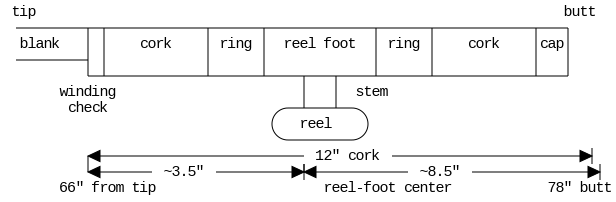
- 12” Portuguese cork (78” − 12” = cork starts at 66”). Shape it as one long cigar or a straight full-wells with a slight swell under the reel.
- Rings: 2 nickel-silver or aluminum sliding rings sized to the cork’s diameter at the reel position, about 7/8–1”. Lap the reel foot on the cork first; the rings should press it down snugly, not just touch.
- Reel position: about 8.5” from the butt end to the center of the reel foot, then fine-tune by balance and forearm length. Hold it the way you’d fish it: the butt end should just reach the inside of your forearm.
- Tradeoff: the lightest, cleanest, and most period-correct option, but rings can creep when it’s cold and wet. The fix is a strip of electrical tape under the foot or a slight taper in the cork so the rings jam.
Option B: skeleton seat (modern, locks solid)
Section titled “Option B: skeleton seat (modern, locks solid)”A graphite skeleton seat (Fuji and ALPS make spinning versions in 16–18 mm) with split fore and rear grips. It’s mounted on a built-up arbor over the hex (masking tape or cork rings shaped round, epoxied).
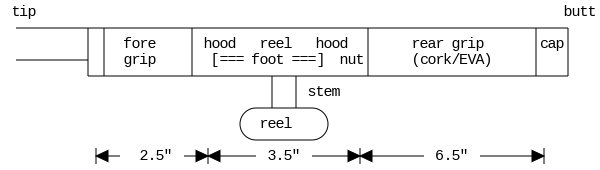
- Fixed hood on one end, threaded hood plus lock nut on the other. Either direction works. Pick whichever puts the threads where your fingers don’t sit.
- Tradeoff: the reel never moves, but you’ll have to make an arbor and it looks modern on cane.
Fly vs. spin at a glance
Section titled “Fly vs. spin at a glance”| Fly rod | Spinning rod | |
|---|---|---|
| Reel position | at the butt, below the grip | 8–9” up from the butt, mid-handle |
| Reel orientation | hangs below | hangs below on a stem |
| What carries the cast | the line’s weight | the lure’s weight |
| Line control | line hand strips line | index finger on the spool, then turn the handle |
| Guides | small snakes, small stripper | fewer, larger single-foot guides; big stripper ring |
| Handed-ness | usually reel with the off hand | same: cast right, crank left (most reels swap sides) |
Guides and tiptop
Section titled “Guides and tiptop”Line comes off a spinning spool in big coils, so the first guide (the stripper) is large and sits high. The rest step down to choke the coils into a straight line. Use light single-foot guides to keep weight off the cane tip. A rule of thumb from the bamboorodmaking page is one guide per foot of rod, plus one.
| Position (from tip) | Ring size | Notes |
|---|---|---|
| 0” | 6 mm ring, 6/64 tube | across-corners at the tip ≈ 0.092”, so 6/64 (0.094”) only just fits; see the tiptop note under the spec table |
| 5” | 6 mm | |
| 11” | 6 mm | |
| 18” | 7 mm | |
| 26” | 8 mm | |
| 35” | 10 mm | just tip-side of the splice (36.75–41.25”), so it doubles as an alignment mark |
| 47” | 16 mm, high frame | stripper, about 22” ahead of the reel foot; butt-side alignment mark |
These are starting positions. Tape the guides on, mount the reel, and run the line through. Then do a static load test: tie the line off and bend the rod to about 90°, then move guides until the line follows the blank’s curve without touching it. Then cast with tape before wrapping. Wrap with fine thread, same as a fly rod; spinning guides don’t need special wrapping.
You want a 1000-size spinning reel (Shimano 1000 / Daiwa LT 1000–2000) that’s light (≈5.5–6.5 oz) and holds ~100+ yd of 4–6 lb mono. A heavier reel will make a 6’6” cane rod feel butt-heavy.
- Modern pick: Shimano Stradic FM 1000HG (SKU ST1000HGFM): ~185 g / 6.5 oz, 6.0:1 gear, 3 kg drag. It’s the trout standard: smooth, durable, and easy to get serviced. FM is the current generation (the earlier one was FL), and HG means “high gear.”
- Co-pick: Daiwa Ballistic MQ LT 1000: 6.2 oz on Field & Stream’s 2026 test scale. It’s the equal of the Stradic, so buy whichever is cheaper when you’re ready.
- Shop by spec, not by name: 5.5–6.5 oz, 1000 size, aluminum spool, a drag that’s smooth at low settings (you’ll be running about 2 lb), and a handle that swaps sides. Published weights vary by source and model year, so confirm on the maker’s spec sheet. If you can, mount the reel on a rod in a shop to feel the balance.
- Period-correct on cane: a vintage Mitchell 308 ultralight (the 408 is its faster-geared sibling: blue, with a screw-in handle). Check which side the handle cranks on any one you buy, because the vintage models vary. Look for a serviced one, because drags and bail springs on 50-year-old reels are the weak point.
Spinning basics for a fly angler:
- Spool it right. Line comes off the filler spool the same direction it goes onto the reel, or you’ll fight twist all day. Fill to about 1/8” below the spool lip.
- Set the drag to about 1/3 of the line test. With 6 lb line, the drag should slip at a ~2 lb pull on a scale.
- Casting: pin the line on your index finger, open the bail, cast, and lift your finger to release. Touch the spool rim to feather or stop the lure. Close the bail by hand, not with the crank; that’s what stops line twist and loops.
- Spinners twist line. Run a small ball-bearing swivel 18” ahead of any inline spinner.
Tackle
Section titled “Tackle”Everything below is single-hook or easy to convert, so the same box works on Hatchery Supported water (anything goes) and on the East Fork DH (one single hook, no bait). For DH, swap trebles for single siwash hooks with split rings and pliers, and take the second hook off a jerkbait.
Line: 6 lb mono for the mainstem; 4 lb is optional on the small DH runs. Mono is better than braid in December, because braid holds water and ices in the guides on freezing mornings. A 3’ 6 lb fluorocarbon leader is optional in gin-clear water.
| Lure | Size | How to fish it in winter | DH-legal? |
|---|---|---|---|
| Marabou or hair jig (black/olive, white) | 1/32–1/16 oz | Dead-drift or swim slowly along the bottom of deep pools. The top pick for cold water. | ✅ single hook |
| Trout Magnet–style micro plastic on a 1/64 oz head | 1/64 oz | Under a small float through the slow pools. Deadly on stockers. | ✅ |
| 2” curly-tail grub / small Ned rig | 1/16 oz head | Hop it slowly for winter smallmouth on the mainstem’s deep bends. | ✅ |
| Inline spinner (Panther Martin, Mepps #0–1, Rooster Tail) | 1/16–1/8 oz | Retrieve slowly, just fast enough to turn the blade. Swap to a single hook for DH. | 🔧 convert |
| Spoon (Kastmaster, Phoebe) | 1/12–1/8 oz | Count it down, then flutter it back slowly. Good for long casts across the mainstem. | 🔧 convert |
| Small floating or suspending minnow (Rapala F3/F5, CD3) | ~1/8 oz | Twitch and pause. Big browns and smallmouth will hit it. | 🔧 one single hook |
| Nightcrawler on #8 hook + split shot | — | Hatchery Supported water only (bait banned on DH) | ❌ |
Terminal kit: small ball-bearing swivels, round split shot (BB–#4), 1/2” float, #8 and #10 single hooks, single siwash hooks for conversions, a split-ring tool, forceps, a rubber-mesh net, and a small Plano box.
How to fish it: fish 11 a.m.–3 p.m., when the water is warmest. Fish slow and deep, close to the bottom of the deepest slow pools and the outside bends. Do several casts per spot before moving. Browns are spawning or just finished, so stay off redds: the clean, light-colored gravel patches.
Build checklist
Section titled “Build checklist”Check the taper: done in caneDNA for variant D (see Taper). Decide D vs. E before cutting (variant E); the butt-section mill table differs.- Split culms into 5–6’ sections as in the class build. Stagger nodes 3×3, and keep them out of the 36–42” splice zone.
- Rough → heat-treat → finish each section on the standard bed. Mill the tip to 44” and the butt from 34” so both joints stay possible.
- Dry bind, then glue both sections.
- Choose the joint: cut and whip the 4.5” scarf bevels (36.75–41.25”), or trim square at 39” and fit a 12/64 ferrule.
- Shape the 12” cork; fit the reel foot and rings at about 8.5” from the butt.
- Tape the guides and do the static load test, then a casting test. Then wrap and finish.
- Buy the reel and line, then build the tackle box above.
- Before the first trip, confirm the Hap Simpson reach’s designation, the NCWRC stocking schedule, and USGS flows.
Graphite alternative: a Mud Hole build
Section titled “Graphite alternative: a Mud Hole build”This is the same rod in graphite, built from Mud Hole parts: a weekend build that fishes this winter while the cane rod is still in the binder. Everything else on this page (reel, line, tackle, how to fish it) carries over unchanged.
Blank: MHX S782-2
Section titled “Blank: MHX S782-2”| MHX S782-2 (pick) | MHX S782 | MHX S842-2 | |
|---|---|---|---|
| Length / pieces | 6’6” / 2 | 6’6” / 1 | 7’0” / 2 |
| Power / action | Light / Fast | Light / Fast | Light / Fast |
| Line / lure | 4–8 lb / 1/16–5/16 oz | 4–8 lb / 1/16–5/16 oz | 4–8 lb / 1/16–5/16 oz |
| Tip size / butt | 4.5 / 8.50 mm (0.335”) | 4.5 / 0.33” (8.40 mm) | 5.0 / 0.34” |
| Weight | 1.25 oz | 1.25 oz | 1.4 oz |
| Price (Oct 2026) | $61.00 | $58.50 | $66.25 |
The S782-2 matches the cane rod’s spec (6’6”, light, 1/16-oz lures at the bottom of its range) and breaks down to about 40” for the car. Pick the S782 if you want the one-piece feel; the specs are identical. Pick the S842-2 if you want 6” more reach across the mainstem pools.
Blank diameters are from Mud Hole’s MHX dimensions sheet. They set the handle hardware below. For the S782-2, in mm, measured from the butt:
| From butt | 0 | 2” | 4” | 6” | 8” | 10” | 12” | 14” | 16” | 18” |
|---|---|---|---|---|---|---|---|---|---|---|
| Diameter (mm) | 8.50 | 8.24 | 8.11 | 7.95 | 7.79 | 7.65 | 7.48 | 7.27 | 7.10 | 6.42* |
*As printed. It’s out of line with its neighbors (22” reads 6.77), so measure it yourself.
Handle: Fuji VSS split grip
Section titled “Handle: Fuji VSS split grip”This is Option B from Handle and reel seat, with real parts. The handle runs about 16” from the butt cap to the winding check:
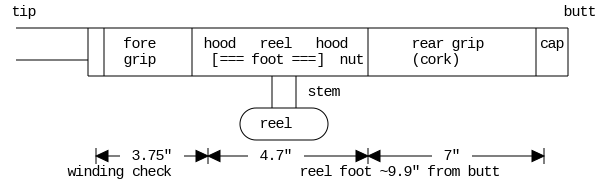
- Reel seat: Fuji VSS size 16 (VSSM-16). It’s 120 mm long with a 13.0 mm ID, the light size that suits a 1000 reel. The blank is 7.6–7.8 mm under the seat, so you’ll build up ~2.6 mm per side with an arbor (polyurethane arbor or masking-tape rings, epoxied).
- Foregrip: Fuji contoured split grip, size 16, cork (FGVSS-16C, 3.75”). It’s made to mate with the VSS 16 nose.
- Rear grip: American Tackle straight rear spinning grip, cork, 7”, 0.250” ID (RG-7S-250), with a CBC-3 composite butt cap per the grip’s size chart. Ream the 0.250” bore out to the blank’s 8.0–8.5 mm. Dry-fit the tenon into the VSS’s rear nut before gluing, because Mud Hole doesn’t list this grip as a VSS match.
- Winding check for a ~7.1 mm (0.28”) blank at the front of the foregrip (the diameter table above reads 7.10 mm at 16” from the butt).
Guides: Fuji KL-H 169H kit (KR-style)
Section titled “Guides: Fuji KL-H 169H kit (KR-style)”Mud Hole’s Fuji KL-H 169H kit is Fuji’s small-reel spinning train (“spinning up to 7’6”“), with Alconite rings on stainless frames. It’s a modern KR-style train: a small, high stripper close to the reel and an early choke guide that straightens the line, followed by a row of small identical runners. That’s lighter and casts farther than the old big-stripper layout. The 4.5 runners match the blank’s 4.5 tip.
Starting layout (inches from the tiptop; reel-foot center ≈ 68” from the tip):
| # | Guide | Ring | From tip | Gap to next (toward butt) |
|---|---|---|---|---|
| tip | Fuji LG micro spinning top, Alconite | 4.5 ring / 4.5 tube | 0 | 3.5” |
| 1 | KT runner | 4.5 | 3.5” | 4.0” |
| 2 | KT runner | 4.5 | 7.5” | 4.5” |
| 3 | KT runner | 4.5 | 12” | 5.0” |
| 4 | KT runner | 4.5 | 17” | 5.5” |
| 5 | KT runner | 4.5 | 22.5” | 6.0” |
| 6 | KB (transition) | 4.5 | 28.5” | 6.5” |
| 7 | KL 5.5M (choke) | 5.5 | 35” | 6.5” |
| 8 | KL 8H (reduction) | 8 | 41.5” | 6.5” |
| 9 | KL 16H (stripper) | 16 | 48” | ~20” to the reel foot |
This is a starting point, not Fuji’s computed layout. Fuji’s 2009 “New Concept” chart for a 6’6” spinning rod puts a bigger stripper at about 45” from the tip with seven guides. This KR kit uses a smaller stripper and nine guides, so the spacing above is my adaptation. Before wrapping:
- Tape everything on.
- Run Fuji’s KR guide placement software (linked from Mud Hole’s KL and KT pages) with a 1000 reel and 6 lb mono.
- Do a static load test (bend to ~90°, line shouldn’t touch the blank).
- Do a cast test, watching the line cone: it should be choked to straight by guide 7.
On the S782-2, keep guide 8 off the ferrule. Mud Hole doesn’t publish the ferrule location. If a guide lands within ~1” of the female ferrule, slide it.
Bill of materials
Section titled “Bill of materials”Prices are Mud Hole’s listed prices as of Oct 31, 2026. A “verify” note means I couldn’t confirm that size’s SKU or price on the page.
| Qty | Item | Mud Hole SKU | Price | Notes |
|---|---|---|---|---|
| 1 | MHX S782-2 6’6” Light Fast 2-pc blank, Slate | S782-2-MHX | $61.00 | or S782-MHX 1-pc $58.50 |
| 1 | Fuji VSS Standard spinning seat, size 16, BC Grey | VSSM-16BC | $5.77 | 120 mm, ID 13.0 mm; CC Silver also offered |
| 1 | Fuji contoured split foregrip, size 16, cork | FGVSS-16C | $9.39 | 3.75” |
| 1 | American Tackle straight rear spinning grip, cork, 7”, 0.250” ID | RG-7S-250 | ~$8–12 (verify) | the 4” is $8.19; ream to fit |
| 1 | American Tackle composite cork butt cap | CBC-3 | from $2.09 | size per the rear-grip chart |
| 1 | Reel-seat arbor (polyurethane), or masking tape | verify | from $2.29 | build ~7.7 → 13.0 mm |
| 1 | Winding check, ~7.1 mm (0.28”) | verify | ~$1–3 | Mud Hole trim parts |
| 1 | Fuji KL-H guide kit 169H, Alconite, BC Grey | BCKLAG169H | $28.90 | KL16H, KL8H, KL5.5M, KB4.5, 5× KT4.5 |
| 1 | Fuji LG micro spinning tip-top, Alconite, BC Grey, 4.5 ring / 4.5 tube | verify size | from $4.25 | the tube must fit the 4.5 tip |
| 1 | Rod-wrapping thread, size A nylon | — | on hand | same as the fly rods |
| — | Rod finish (2-part) + grip/seat epoxy | — | on hand | |
| Parts total | ≈ $125 | plus shipping; reel and line not included |
Graphite build order
Section titled “Graphite build order”- Measure the blank’s spine and mark it; the guides go on the spine’s compression side.
- Ream and dry-fit the rear grip, the VSS seat on its arbor, and the foregrip. Glue them butt-first, seat aligned with the guide side.
- Fit the tip-top. Tape all guides on per the starting layout.
- Mount the reel, then do the static load test and cast test. Adjust.
- Wrap, finish, and cure. A graphite blank needs no varnish, just the guide wraps.
Sources
Section titled “Sources”- BambooRodmaking: spinning rod tapers: Tyree, T&T, P.H. Young, Bernard Hills, Montague-derived tapers, guide spacing
- BambooRodmaking: one-piece rods: converting 2-piece tapers to one piece
- Hexrod technical documentation
- French Broad Paddle Trail access points
- Swim Guide: French Broad at Hap Simpson Park: park facilities
- Fly Fishing NC: Transylvania County trout streams: mainstem Hatchery Supported reach (third-party; verify)
- NCWRC Delayed Harvest stocking schedule
- NCWRC 2025 DH season press release: single-hook artificial rule
- USGS 03443000 French Broad River at Blantyre
- Field & Stream: best trout spinning reels (2026): Ballistic MQ LT 1000 tested weight
- TackleDirect: Stradic FM ST1000HGFM: Stradic specs
- Mud Hole product pages (Oct 31, 2026): MHX light spinning blanks, Fuji VSS seat, Fuji VSS foregrip, American Tackle rear grips, butt caps, Fuji KL-H guide kits, Fuji LG Alconite tip-top
- MHX blank dimensions sheet (PDF)
- Fuji, Spinning Rods: New Concept Guide Placement chart (via Mud Hole’s Fuji Concept Guide Spacing PDF)